
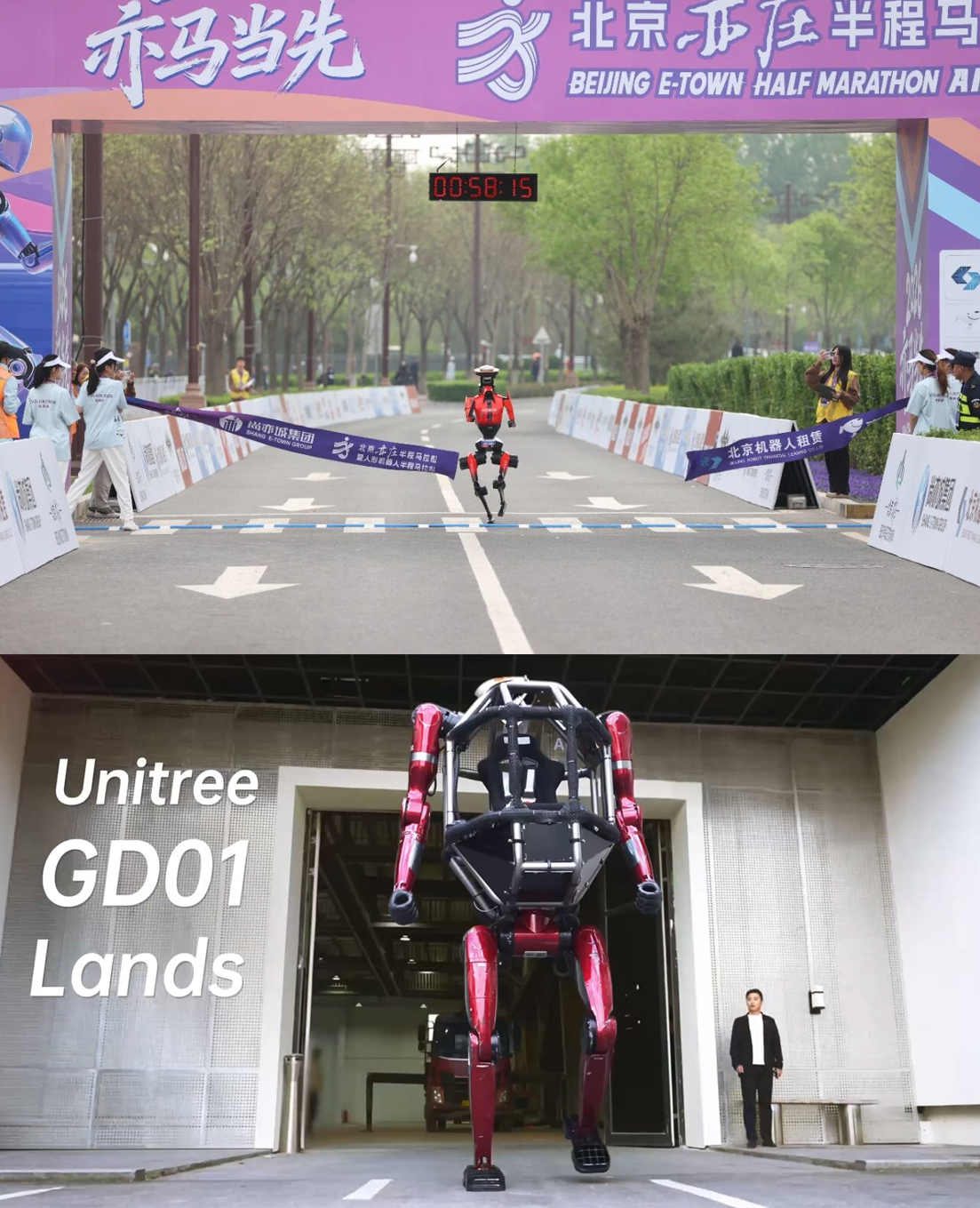
Humanoid Robots Beats Human in 2026 Beijing Half Marathon
On April 19, 2026, the Humanoid Robot Half-Marathon took place in Beijing E-Town, marking one of the most visible public demonstrations of humanoid robot endurance and mobility to date. The event was organized in a “human-robot co-run” format, where human runners and humanoid robots competed on parallel routes separated by barriers or green belts. The robots covered the official half-marathon distance of 21 kilometers.
The most striking result came from a humanoid robot developed by Honor, which completed the race in 50 minutes and 26 seconds. This time was faster than the human half-marathon world record of 57 minutes and 20 seconds, set by Jacob Kiplimo at the 2026 Lisbon Half Marathon. Compared with the previous year’s winning time of around 2 hours and 40 minutes, this represents an improvement of more than threefold, highlighting the rapid acceleration of humanoid robot performance within just one year. According to Reuters, Honor’s robots took the top three positions among the humanoid competitors, with the winning robot operating through autonomous navigation.

The scale of the event also underlined the rapid development of the field. According to official figures reported by Global Times, the race brought together 102 robot teams, 26 brands, and more than 300 humanoid robots. A total of 47 teams completed the race: 18 through autonomous navigation and 29 through remote control. This represented a major improvement compared with the previous year, when the winning robot finished in around 2 hours and 40 minutes.
Technically, the race highlighted several key development areas for humanoid robotics: long-duration locomotion, energy management, thermal control, balance, and autonomous navigation. IDC noted that the 2026 Beijing Humanoid Robot Half-Marathon reflects a broader shift in the sector from isolated technical demonstrations toward more systematic performance validation. Technologies such as multi-sensor perception, LiDAR, vision systems, IMUs, real-time mapping, reinforcement-learning-based motion control, hot-swappable batteries, and liquid cooling were among the capabilities emphasized during the event.
The race also had a strong international dimension while Honor’s Team Monkey King won the overall race with a time of 50:26, the Technical University of Munich received the “Best International Team Award” as a separate recognition for international participation. with its “Tienkung Ultra” robot in 3 hours and 35 minutes. The TUM team monitored motor temperature, battery status, and speed throughout the race, changing the robot’s batteries three times. Their participation showed that speed alone is not the only benchmark for humanoid robots; system reliability, thermal stability, and energy efficiency remain equally critical.
Overall, the 2026 Beijing Humanoid Robot Half-Marathon can be seen as a milestone for the humanoid robotics industry. Beyond the headline result, the event demonstrated how quickly humanoid systems are advancing in endurance, mobility, autonomy, and operational stability. It also provided a public benchmark for comparing technical progress across different teams, platforms, and control approaches.
IDC expects the humanoid robotics market to move from technical feasibility toward commercial scalability over the next several years. The firm projects that global humanoid robot shipments could exceed 510,000 units by 2030, with competition increasingly shifting from impressive demonstrations to real operational value.
Sources & Further Reading:
- https://www.reuters.com/sports/humanoid-robots-race-past-humans-beijing-half-marathon-showing-rapid-advances-2026-04-19
- https://english.beijing.gov.cn/latest/news/202603/t20260306_4550687.html
- https://www.humanoidrobotmarathon.com
- https://www.globaltimes.cn/page/202604/1359229.shtml
- https://www.idc.com/resource-center/blog/humanoid-robotics-commercialization-2026
- https://www.tum.de/en/news-and-events/all-news/press-releases/details/tum-roboter-gewinnt-best-international-team-award
- https://english.beijing.gov.cn/latest/news/202604/t20260419_4593508.html
– – – – – – – – – – – – – – – – – – – – – – – – – –
– – – – – – – – – – – – – – – – – – – – – – – – – –
Can Humanoid Robots Really Handle Household Chores? UniX AI and Reflex Robotics Think So
Humanoid robots capable of handling household chores are no longer limited to futuristic lab demonstrations. Chinese robotics company UniX AI claims its latest humanoid robot, “Panther,” is designed for real-world home environments.
In videos released by the company, Panther is seen making beds, preparing breakfast, organizing laundry, and performing basic home management tasks. According to the company, the goal is to create a general-purpose domestic assistant that can operate in everyday living spaces rather than specialized industrial settings.

At the same time, discussions across social media and robotics communities have raised questions about how autonomous the robot actually is. Some observers speculate that certain demonstrations may involve “teleoperation” a method where human operators remotely assist or control the robot during tasks. Critics argue that the current state of AI and robotics still makes fully autonomous execution of complex household activities extremely challenging.
So far, there is no independent technical report publicly confirming or disproving these claims. UniX AI maintains that its robots are powered by proprietary AI systems and are being tested in real residential environments. Because of this, the debate remains open, and it is important to separate confirmed information from online speculation.
Beyond the controversy, the company’s broader ambition is attracting attention across the robotics industry. UniX AI says it is developing humanoid service robots for multiple sectors including:
- Household assistance
- Hospitality and hotels
- Reception and guiding
- Education
- Security and inspection services
Its Panther and Wanda robot platforms combine mobile movement systems with dual robotic arms, aiming to improve stability and practical interaction in human-centered spaces.
The company also highlights three core AI technologies behind its robotics platform:
- UniTouch: A multimodal perception system combining visual and tactile sensing
- UniFlex: An imitation-learning motion framework designed to replicate human actions
- UniCortex: A decision-making and long-task planning system for adaptive behavior
According to UniX AI, these systems are intended to help robots learn tasks more naturally and adapt to changing home environments without constant reprogramming.
Whether Panther is currently fully autonomous or still partially dependent on remote human assistance, the bigger story may be the direction of the industry itself. Robotics companies are increasingly shifting from controlled demonstrations toward real-life deployment scenarios.
Even if today’s systems still require some level of human supervision, technologies like these could eventually reshape elderly care, disability support, hospitality services, and everyday domestic work.
The idea of a true home assistant robot — long considered science fiction — is now moving closer to commercial reality.
The other company Reflex Robotics, a startup co‑founded by MIT alumni, is building a general‑purpose humanoid robot designed to automate repetitive work in warehouses and factories. Unlike most humanoids that use walking legs, the Reflex robot uses a wheeled base, which the company says is 2–3x cheaper to build, provides passive stability, and delivers up to 16+ hours of battery life on a single charge — about 5× longer than legged designs. The robot carries dual arms with high payload capacity, can be teleoperated remotely by human controllers, and learns from demonstrations to improve autonomy over time. Reflex has partnered with logistics firms to pilot the system in live warehouse environments.

Sources & Further Reading:
- https://www.unix-group.ai/Panther
- https://www.youtube.com/watch?v=fsHBGvXc-Js
- https://www.reflexrobotics.com
- https://news.mit.edu/news-clip/techcrunch-226
- https://www.originofbots.com/robot/reflex-humanoid-by-reflex-robotics-details-specifications-rating
- https://robohorizon.uk/en-gb/videos/reflex-laundry-robot-demo
– – – – – – – – – – – – – – – – – – – – – – – – – –
– – – – – – – – – – – – – – – – – – – – – – – – – –
South Korea Races to Catch Up as the U.S. and China Lead the Humanoid Robot Market
The global humanoid robotics industry is rapidly evolving, with the United States and China emerging as clear leaders. According to a recent report by SBS 8 News, South Korea is now working to close the gap as competition in the sector intensifies.
One of the most notable signs of China’s growing dominance is the increasing visibility of Chinese-made humanoid robots in South Korea. Even major retail stores in the country have begun displaying and selling robots developed by Unitree Robotics, highlighting China’s ability to quickly commercialize robotics technology.
Meanwhile, South Korean robotics company ROBOTIS is preparing to launch an affordable humanoid robot in the first half of 2026. The robot is expected to stand approximately 130 centimeters tall and weigh around 30 kilograms.

To remain competitive against Chinese manufacturers, ROBOTIS aims to price the robot at around 10 million Korean won. Rather than targeting individual consumers, the company plans to focus primarily on businesses, universities, and research institutions.
In the United States, companies such as Tesla continue to lead through the integration of advanced artificial intelligence and robotics systems. Their focus remains on developing highly sophisticated humanoid platforms for future commercial use.
China, on the other hand, is pursuing a different strategy. With strong government support, companies like Unitree Robotics are prioritizing mass production and lower pricing, allowing them to scale quickly in global markets.
The report also highlights South Korea’s ongoing challenges. Experts from Seoul National University Robotics Laboratory warned that the country still lacks a strong domestic ecosystem for key robotic components, increasing the risk of dependence on Chinese suppliers.
To address these concerns, the South Korean government has announced its ambition to position the country among the world’s top three leaders in humanoid robotics.
As the global race for humanoid robot dominance accelerates, South Korea faces growing pressure to strengthen its technological capabilities before the gap with the U.S. and China becomes even wider.
Sources & Further Reading:
– – – – – – – – – – – – – – – – – – – – – – – – – –
– – – – – – – – – – – – – – – – – – – – – – – – – –
Schaeffler Wins Hermes Award for Breakthrough Humanoid Robot Actuator Platform and Plans Deployment of 1,000+ Aeon Robots by 2032
Schaeffler has been awarded the Hermes Award for its integrated actuator platform designed for humanoid robotics. The award recognizes outstanding technological innovation with strong industrial relevance, and is considered one of the most prestigious honors in the global engineering and manufacturing sector.
The winning technology was developed by Schaeffler and focuses on providing a highly integrated actuator system that functions as a core “muscle” component for humanoid robots. According to the company, the platform achieves around 20% more compact design compared to conventional solutions, enabling more agile and space-efficient robot architectures. It also delivers higher performance by generating maximum torque while maintaining low operating temperatures, which is critical for sustained robotic motion. In addition, the system is designed to be scalable, supporting cost reduction and faster adoption of service and industrial humanoid robots.

Image: Schaeffler
The jury highlighted the solution as a potential game-changer in humanoid robotics, especially due to its combination of compactness, efficiency, and scalability. This recognition places Schaeffler’s development at the center of ongoing efforts to advance next-generation robotics and automation systems.
The competition also featured strong finalists such as Festo and Ziehl-Abegg SE, both known for their advanced engineering solutions in industrial automation. Despite this strong field, Schaeffler’s humanoid robotics actuator platform was selected as the winner.
The award was presented as part of the Hannover Messe, which is one of the most important global platforms for industrial innovation, automation, and energy technologies.
Following its Hermes Award win at Hannover Messe for its breakthrough humanoid robot actuator platform, Schaeffler is now significantly expanding its industrial robotics ambitions.
The German motion technology company announced a major expansion of its partnership with Hexagon Robotics, including plans to deploy at least 1,000 Aeon humanoid robots across Schaeffler’s global production network by 2032.
The deployment program follows a successful 2025 pilot in live manufacturing environments, where Aeon humanoids operated at multi-machine production stations handling loading, unloading, and automated part inspection tasks under real factory conditions.
During the pilot phase, the robots utilized Hexagon Robotics’ full sensor suite and spatial intelligence systems to perform high-precision manipulation workflows inside active production lines. According to the companies, additional automated inspection applications are expected to begin rolling out by the end of 2026.
The partnership is strategically significant because it goes beyond a standard supplier relationship. While Hexagon Robotics provides the Aeon humanoid platform, Schaeffler will supply high-precision rotary actuators used in key robotic joints such as shoulders and elbows.
This positions Schaeffler not only as a future humanoid robot operator, but also as a critical component supplier powering next-generation humanoid systems.
According to Reuters, the broader agreement could ultimately involve between 1,000 and 2,000 humanoid robots deployed across Schaeffler facilities worldwide, making it one of the largest publicly announced humanoid manufacturing rollouts in Europe to date. Reuters also reported that Schaeffler will become a preferred actuator supplier for Humanoid’s robotic platforms under a long-term supply agreement.
The companies say the primary objective is to generate large-scale real-world production data that can accelerate humanoid deployment across additional industrial use cases.
The announcement signals a broader shift taking place inside advanced manufacturing: humanoid robots are rapidly moving beyond experimental demonstrations and entering real industrial production environments at scale.
Sources & Further Reading:
- https://www.schaeffler.com/en/media/press-releases/press-releases-detail.jsp?id=88184513
- https://www.hannovermesse.de/en/news/news-articles/schaeffler-wins-the-2026-hermes-award
- https://www.schaeffler.de/de/news_medien/pressemitteilungen/pressemitteilungen_detail.jsp?id=88184513&ref=rss
- https://www.schaeffler.com/en/investor-relations/events-publications/ir-releases/ir_releases_detail.jsp?id=88184988
- https://hexagon.com/company/newsroom/press-releases/2026/hexagon-schaeffler-deploy-aeon-humanoids-across-global-factory-network
- https://www.reuters.com/business/humanoid-deploy-up-2000-robots-schaeffler-plants-2026-05-13
- https://www.engineering.com/hexagon-schaeffler-expand-aeon-robot-partnership
– – – – – – – – – – – – – – – – – – – – – – – – – –
– – – – – – – – – – – – – – – – – – – – – – – – – –
AGIBOT Unveils New Generation of Embodied AI Robots at Partner Conference 2026
Chinese robotics company AGIBOT announced a new lineup of embodied AI robots and foundational AI models during its Partner Conference 2026, positioning the year as the beginning of large-scale commercial deployment for physical AI systems.
According to the company, AGIBOT’s new “One Robotic Body, Three Intelligences” architecture combines:
- Locomotion Intelligence
- Manipulation Intelligence
- Interactive Intelligence
into a unified embodied AI ecosystem.
New Robotic Platforms Announced
AGIBOT introduced five robotic platforms designed for real-world industrial and service applications:
- AGIBOT A3: A next-generation humanoid robotics platform focused on advanced mobility and real-world task execution equipped with 10 hour endurance and 10 second battry swapping.

AGIBOT G2 Air: A lightweight mobile humanoid robot as agile single arm mobile manipulator designed and developed for interactive service and commercial environments.

G2 Air on left and A3 on right
OmniHand 3 Ultra: An advanced robotic hand system built for high-precision manipulation and dexterous operations features 22+3 DOF tendon driven system with response time less than 0.3 second and as 500 gr which has a 10:1 load to weight ratio.

D2 Max: A quadruped robot engineered for industrial inspection, logistics, and outdoor operational scenarios.

MEgo: A body-free data collection system created to accelerate scalable physical AI training and embodied learning.
Eight Foundational AI Models Revealed
In addition to the hardware platforms, AGIBOT unveiled eight new foundational AI models supporting embodied intelligence. The models are designed to enhance robotic reasoning, movement, interaction, and object manipulation in dynamic physical environments.
The company stated that its focus is shifting from experimental robotics demonstrations toward scalable real-world deployment across industries including manufacturing, logistics, retail, security, and smart services.
AGIBOT also revealed that it has already produced its 10,000th robot, signaling rapid growth in the embodied AI sector.
Sources & Further Reading:
- https://www.agibot.com/APC2026
- https://robotsbeat.com/agibot-apc-2026-deployment-year-one-five-platforms-aima-architecture
- https://www.prnewswire.com/news-releases/agibot-declares-2026-deployment-year-one–at-apc-2026-accelerating-the-era-of-embodied-ai-productivity-302746171
- https://www.prnewswire.com/apac/news-releases/the-first-hong-kong-embodied-ai-industry-summit-and-agibot-partner-conference-2026-hong-kong-opens-302770944
- https://www.aparobot.com/robots/agibot-a3
- https://www.agibot.com/products/G2
- https://www.gadgetmatch.com/agibot-2026-partner-conference/
– – – – – – – – – – – – – – – – – – – – – – – – – –
– – – – – – – – – – – – – – – – – – – – – – – – – –
Figure AI Scales Humanoid Robot Production 24x
Figure AI has reached a major manufacturing milestone in humanoid robotics, increasing production of its Figure 03 humanoid robot from one unit per day to one unit per hour in under 120 days.
More than 350 third-generation Figure 03 humanoid robots have already been produced at BotQ, the company’s dedicated high-volume manufacturing facility built specifically for humanoid robot production.
The achievement marks an important transition for Figure AI as it moves beyond prototype development and toward scalable industrial manufacturing.

According to the company, BotQ now operates with more than 150 connected workstations, over 50 in-process inspection checkpoints, and more than 80 end-of-line functional tests performed on every robot. Figure AI also reported an end-of-line first-pass yield above 80%, while battery assembly lines achieved yield rates of 99.3%.
To support the rapid production ramp, the company has already manufactured more than 9,000 actuators across multiple Figure 03 variants.
Figure AI also introduced new capabilities within its Helix AI system, including perception-conditioned whole-body control that enables Figure 03 robots to autonomously navigate stairs, ramps, and uneven terrain using onboard stereo vision systems without task-specific programming.
The company views the expanding humanoid fleet as critical for accelerating real-world data collection and improving robotic autonomy at scale.
The production ramp comes amid intensifying competition across the humanoid robotics industry, where companies such as Tesla, Agility Robotics, Apptronik, and several Chinese robotics firms are racing to commercialize general-purpose humanoid labor systems.
The latest expansion further signals that humanoid robotics is rapidly evolving from experimental R&D into large-scale industrial manufacturing infrastructure.
Sources & Further Reading:
- https://www.figure.ai/news/ramping-figure-03-production
- https://theaiinsider.tech/2026/05/01/figure-ai-ramps-up-production-to-one-humanoid-robot-per-hour
- https://interestingengineering.com/ai-robotics/figure-humanoid-robot-production-scale-up
– – – – – – – – – – – – – – – – – – – – – – – – – –
– – – – – – – – – – – – – – – – – – – – – – – – – –
Humanoid Robots Are Now Handling Packages in Live Warehouse Operations
Humanoid robots are no longer confined to research labs or carefully staged demonstrations. Across both the United States and China, companies are now deploying humanoid systems directly into live logistics and industrial workflows at increasingly meaningful scale.
In the United States, Figure AI recently demonstrated its Figure 03 humanoid robot autonomously sorting packages on a live conveyor belt using onboard perception and real-time motion control systems.

Image: Figure
The robot was shown identifying, flipping, scanning, and sorting parcels dynamically while adapting to changing package orientations and conveyor conditions in real time. In one notable demonstration, engineers intentionally disabled part of the robot’s leg system during operation. Despite the impairment, the humanoid continued completing tasks before independently walking itself toward maintenance.
The demonstration highlights a broader industry objective: building humanoid systems capable of maintaining operational continuity under unpredictable real-world conditions rather than relying on tightly scripted automation environments.
At the same time, a much larger commercial deployment is already unfolding in China.
Beijing-based RobotEra has begun deploying its L7 humanoid robots across logistics centers through partnerships with SF Express and China Post.
According to the company, the L7 humanoids operate directly on conveyor sorting lines where they pick packages from moving belts, identify parcels using onboard vision systems, and sort them into the correct destination lanes autonomously.
RobotEra claims the systems currently achieve roughly 85% of human-level sorting efficiency while operating continuously around the clock.
More importantly, the company confirmed that it has now entered thousand-unit-scale delivery operations for the L7 platform following more than $350 million in recent funding from investors including SF Group, Sequoia China, Hillhouse, and multiple industrial partners.
The distinction is important: RobotEra did not claim that thousands of robots are already fully operational simultaneously. Instead, the company confirmed that manufacturing and delivery operations have entered thousand-unit scale a milestone that may ultimately matter more than any individual pilot deployment.
Scaling humanoid robotics is fundamentally different from scaling software.
Large-scale deployment tests not only the robot itself, but also manufacturing throughput, supply chain resilience, maintenance infrastructure, software update systems, uptime economics, and the ability to operate under the full variability of real industrial environments.
What makes RobotEra’s rollout particularly notable is the commercial structure behind it. SF Group functions both as a strategic investor and as a primary deployment partner, creating a tightly integrated operational feedback loop between robotics development and real-world logistics operations.
The broader implication extends far beyond logistics.
Humanoid robotics is increasingly transitioning from isolated proof-of-concept demonstrations into operational infrastructure for repetitive industrial labor. The companies leading this transition are not merely developing robots and they are building scalable deployment ecosystems capable of supporting thousands of machines inside real production and logistics networks.
The central question is no longer whether humanoid robots can function in industrial environments.
The question is which industries still depend heavily on repetitive human labor within predictable operational boundaries and how quickly those workflows can be automated at scale.
Sources & Further Reading:
- https://www.techradar.com/ai-platforms-assistants/figure-ai-streamed-humanoid-robots-sorting-packages-for-8-hours-straight-and-not-everyone-is-convinced-it-was-fully-real
- https://www.reddit.com/r/robotics/comments/1t0o5ke/thousands_of_robotera_l7_humanoids_to_enter
– – – – – – – – – – – – – – – – – – – – – – – – – –
– – – – – – – – – – – – – – – – – – – – – – – – – –
Galbot Raises Over $300 Million, Setting Record in
China’s Humanoid Robotics Industry
Chinese humanoid robotics company Galbot has officially announced the successful completion of a new funding round exceeding $300 million, marking the largest single financing round ever recorded in China’s humanoid robotics sector. Following the investment, the company’s valuation has reportedly reached $3 billion, making Galbot the highest-valued humanoid robotics company in China to date.
According to the company, the funding highlights growing investor confidence in embodied AI and Galbot’s vertically integrated approach to robotics development. The company develops its own large-scale embodied datasets, AI foundation models, and robotic hardware entirely in-house.
Galbot stated that its humanoid robots are already being deployed across multiple industries, including manufacturing, logistics, retail, and healthcare. The company is currently working with major industrial partners such as CATL and Bosch, while also operating autonomous retail stores, smart warehouse systems, and hospital assistance solutions.
The company said the newly raised capital will be used to accelerate mass production, improve embodied AI capabilities, and expand commercial deployments globally.
Sources & Further Reading:
- https://www.prnewswire.com/news-releases/galbot-secures-over-300-million-in-new-funding-breaking-records-with-3-billion-valuation-in-chinas-humanoid-robot-sector-302647204.html
- https://roboticsandautomationnews.com/2025/12/20/humanoid-robot-maker-galbot-raises-300-million-and-reaches-3-billion-valuation/97783
- https://www.finsmes.com/2025/12/galbot-raises-over-300m-in-funding.html
– – – – – – – – – – – – – – – – – – – – – – – – – –
– – – – – – – – – – – – – – – – – – – – – – – – – –
China’s Unitree Unveils Rideable Transforming Mecha Robot GD01
Chinese robotics company Unitree Robotics has introduced the GD01, a rideable transforming mecha robot that is already drawing comparisons to science fiction franchises like Transformers, Pacific Rim, and Gundam. The company describes the GD01 as the world’s first production-ready manned transformable mecha designed for civilian use.

Image: Unitree
The launch video, which quickly went viral online, shows the robot walking through industrial environments, transforming between modes, and smashing through a concrete-block wall. The footage also features Unitree founder Wang Xingxing piloting the machine from an exposed cockpit integrated into the robot’s torso.

The GD01 may not become a mainstream transportation platform anytime soon, but it represents another sign of how rapidly embodied robotics is evolving in China. The key question moving forward is whether transformability can provide meaningful real-world advantages such as improved adaptability, mobility, safety, and operational flexibility — rather than simply serving as a technological spectacle.
Unitree itself ended the launch announcement with a warning that quickly became one of the internet’s favorite lines from the reveal:
“Please use the robot in a friendly and safe manner.”
Sources & Further Reading:
- https://www.theverge.com/tech/929487/unitree-gd01-giant-mech-suit-robot
- https://cnevpost.com/2026/05/12/unitree-unveils-manned-mecha-gd01
- https://www.euronews.com/video/2026/05/13/chinas-unitree-unveils-transformable-humanoid-mecha-robot-with-cockpit
- https://int.auto.pub/en/unitree-gd01-piloted-transforming-robot
– – – – – – – – – – – – – – – – – – – – – – – – – –
– – – – – – – – – – – – – – – – – – – – – – – – – –
MIT Develops Silent Artificial Muscles for Robots and Wearable Technology
Researchers at Massachusetts Institute of Technology have introduced a new type of artificial muscle called Electrofluidic Fiber Muscles (EFMs), a breakthrough that could significantly improve the future of soft robotics, wearable devices, and assistive technologies.
The newly developed muscles are designed to be lightweight, flexible, and quiet, allowing them to be integrated directly into fabrics and wearable systems without the bulky compressors or rigid hardware commonly used in traditional robotic actuators. According to the researchers, the technology could eventually enable clothing that assists human movement, soft robotic systems with more natural motion, and compact medical devices.

Unlike conventional pneumatic systems that require large external pumps, MIT’s Electrofluidic Fiber Muscles generate movement using miniature fiber pumps that are less than 2 millimeters wide. These pumps convert electrical energy directly into hydraulic pressure inside soft fibers, creating strong and controllable motion while remaining highly portable.

The research team says the fibers can be woven into textiles and customized for different applications, potentially opening the door to next-generation smart garments, rehabilitation equipment, and human-assistive exosuits. Because the system operates silently, it may also be more practical for everyday consumer and healthcare environments compared to existing robotic systems.
Researchers also highlighted the efficiency and scalability of the technology, noting that multiple muscle fibers can work together to create larger and more complex movements. The team believes the innovation could play an important role in the growing field of embodied AI and human-machine interaction.
Sources & Further Reading:
https://www.media.mit.edu/projects/electrofluidicmuscle/overview

Leave a Reply