
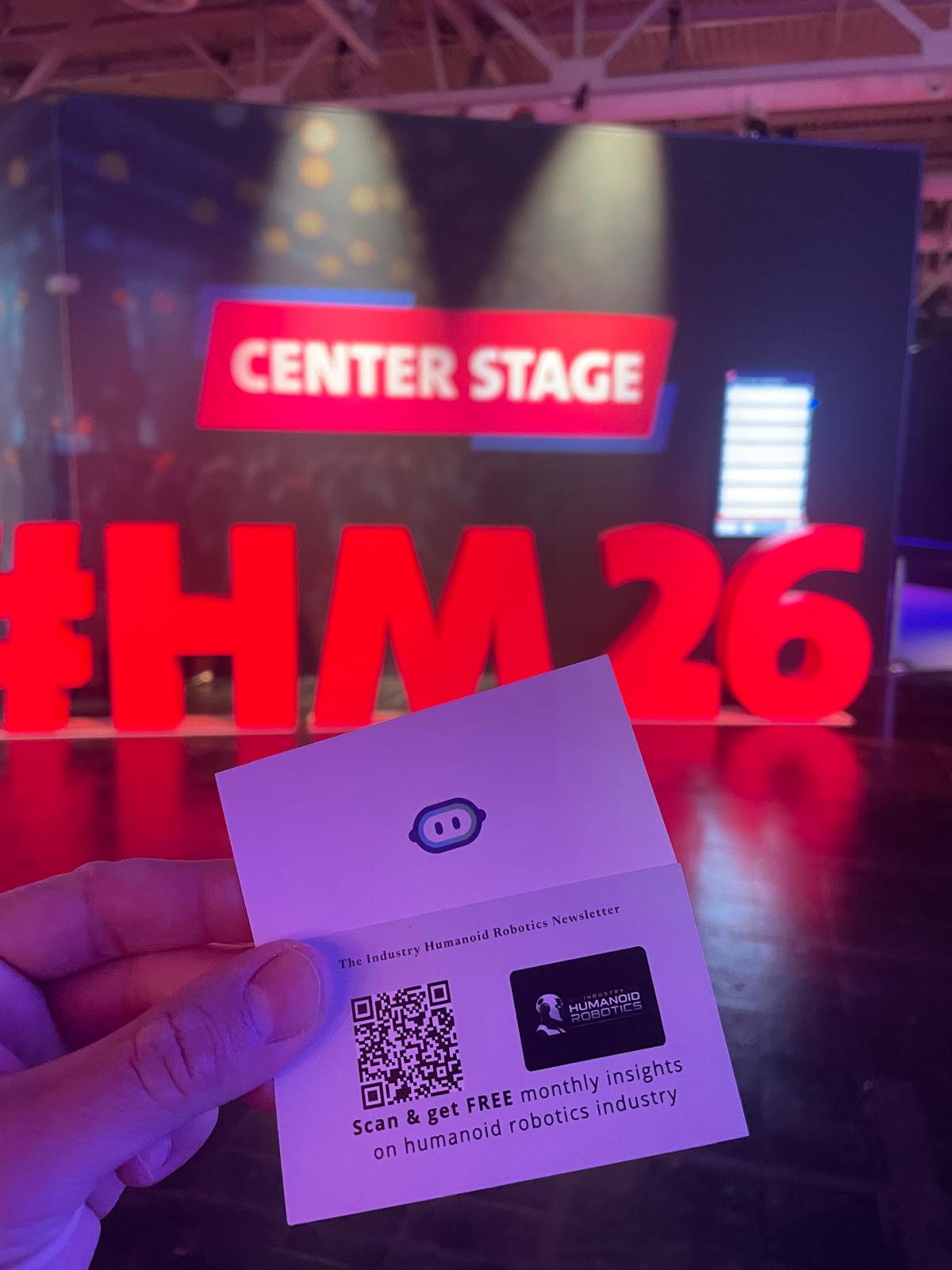
HANNOVER MESSE 2026
Having attended the fair over the past three years, we can say that the shift is striking. This year, humanoid robots have clearly moved from occasional demos to a visible theme, with around +15 companies showcasing their systems.
At the same time, the reality on the ground is more nuanced than the polished videos we often see. Some robots still rely on support to stand, some of them are teleoperated, and a few are limited to controlled demo scenarios. It’s obvious that while the progress is impressive, the technology is still maturing.
Even so, this feels like a clear inflection point that where AI and robotics are beginning to transition from promise to practical industrial exploration.
In this text we will address the exhibition observation under 5 title topic in order, wish you enjoy to read…
– – – – – – – – – – – – – – – – – – – – – – – – – –
– – – – – – – – – – – – – – – – – – – – – – – – – –
1-) Hannover Messe 2026:
Humanoid Robotics are not demo anymore
At Hannover Messe 2026, the clearest shift was this: humanoid robots are no longer stage-level prototypes built for controlled demonstrations.
They are rapidly becoming integrated components of real industrial workflows and production architectures.
In previous years, humanoid robotics was mostly associated with:
- Controlled demo environments with limited movement tasks
- Simple manipulation scenarios (pick-and-place, basic handling)
- Showcase-driven human interaction concepts
In 2026, this framing has fundamentally changed. A significant portion of the systems on display were no longer presented as standalone robots, but as subsystems within larger industrial and AI-driven automation stacks.
1.1. From demo units to production systems
Companies such as Schaeffler & Neura Robotics, Agile Robots, and Hexagon made this transition especially visible. Their approach highlighted a key shift:
- Robots are no longer standalone products
- They function as execution layers within production systems
- They act as physical agents of digital twin environments
- They are not just collaborative assistants, but active process participants
The focus is no longer on what a robot can do in isolation, but on where and how it is embedded within industrial systems.
1.2. AI integration becomes the defining factor
Another major transformation was the deep integration of AI into humanoid systems.
The new generation of robots showcased at the fair demonstrated:
- Multimodal perception (vision, depth, force sensing combined with AI reasoning)
- Real-time environmental adaptation
- Task execution driven by goal-based autonomy rather than fixed programming
This effectively moves humanoid robotics away from traditional automation paradigms and closer to AI-native physical agents operating in dynamic environments.
1.3. A clear signal of industrial reality
Perhaps the most important takeaway from Hannover Messe 2026 is the following:
Humanoid robotics is no longer a speculative future technology, it is entering the early phase of industrial deployment readiness.
This was reflected across multiple exhibitors:
- Schaeffler’s integration-focused manufacturing approach
- Hexagon’s digital twin + execution ecosystem
- Agile Robots’ AI-driven manipulation systems
- China’s scale-oriented players like Agibot and Unitree
Each represents a different layer of the same transformation: The shift from experimental robotics to industrialized embodied AI systems.
– – – – – – – – – – – – – – – – – – – – – – – – – –
– – – – – – – – – – – – – – – – – – – – – – – – – –
2) Germany Leads The Physical AI Layer
One of the most important structural observations at Hannover Messe 2026 is that Germany is not positioning itself as a “humanoid robotics hype player,” but rather as the architect of the physical AI layer that connects industrial systems with embodied intelligence.
Instead of focusing purely on humanoid form factors, German companies are building the underlying infrastructure that allows robots to operate reliably inside real factories: precision mechanics, safety-certified systems, digital twin integration, and AI-driven industrial execution layers.
This is most clearly visible across Schaeffler & Neura Robotics, Hexagon AEON, Agile Robots, and Igus.
2.1. Schaeffler + Neura Robotics: Industrial cognition in production environments
The Schaeffler and Neura Robotics collaboration represents one of the strongest signals of this “physical AI layer” strategy.
Rather than treating humanoid robotics as a standalone product, the focus is on embedding cognitive robotics directly into manufacturing environments.
Key technical direction:
- Torque-controlled collaborative robotic systems
- AI-based perception and environmental understanding
- Real-time force feedback and adaptive motion control
- Human-safe industrial interaction design
This approach effectively transforms robotics from rigid automation tools into context-aware production agents that can adapt dynamically to human workflows.
📌 The key shift here is not form factor, but function: Robots are becoming decision-capable components of industrial processes rather than pre-programmed machines.

2.2. Hexagon AEON — digital twin meets physical execution
Hexagon’s AEON initiative represents another critical pillar of Germany’s physical AI strategy.
Its core value lies in connecting digital twin systems directly to physical robotic execution layers.
Technical direction includes:
- Real-time spatial intelligence and environment mapping
- Synchronization between simulation and physical factory operations
- AI-driven path planning inside dynamic industrial environments
- Closed-loop feedback between virtual models and real-world execution
This creates a system where factories are not just simulated digitally — they are continuously updated, corrected, and executed through AI-driven robotics systems.
📌 In this model, humanoid or robotic systems are not isolated machines, but execution nodes of a continuously running digital factory brain.

2.3. Agile Robots: Physical AI as an industrial operating system
Agile Robots further reinforces Germany’s positioning by moving toward what can be described as a physical AI operating layer for industrial robotics.
Rather than focusing only on mechanical performance, the company integrates:
- Vision-based manipulation systems
- Reinforcement learning for motion control
- AI-driven task execution pipelines
- Industrial-grade precision robotics hardware
This combination allows robots to transition from fixed-task automation to adaptive task execution systems, where behavior is increasingly determined by AI policies rather than static programming.
📌 The strategic shift is clear: robotics is evolving into an AI-native execution system for industrial environments.


Datasheet Source: https://www.agile-robots.com/en/solutions/agile-one/
2.4. Igus — open automation and scalable robotics infrastructure
Igus represents the foundational layer of this ecosystem: scalable, low-cost, and modular automation infrastructure.
Instead of competing in humanoid robotics, Igus focuses on:
- Lubrication-free polymer-based motion systems
- Modular robotic arms and linear automation units
- Low-maintenance industrial design philosophy
- Accessible automation systems for SMEs
This makes Igus a key enabler of physical AI adoption at scale, especially in environments where cost, maintenance, and reliability are more critical than advanced humanoid capabilities.
📌 In essence, Igus provides the “entry layer” into automation, while others build intelligence on top of it.

2.5. Conclusion
Across these four players, a clear pattern emerges:
Germany is not competing in humanoid robotics as a product race, it is building the physical AI infrastructure layer of industrial systems.
- Schaeffler + Neura → Cognitive industrial robotics
- Hexagon → Digital twin to physical execution bridge
- Agile Robots → AI-native robotics operating system
- Igus → Scalable automation infrastructure
Together, they form a stack where robotics is no longer a standalone category, but part of a larger AI-driven industrial execution architecture.
– – – – – – – – – – – – – – – – – – – – – – – – – –
– – – – – – – – – – – – – – – – – – – – – – – – – –
3) China Is Scaling The Humanoid Race
While Germany is building the physical AI infrastructure layer, China is clearly taking a different strategic direction: rapid scaling of humanoid robotics as an industrial and commercial race.
The key distinction is not technological capability alone, but speed of iteration, cost reduction, and deployment scale. At Hannover Messe 2026, this difference was visible across multiple Chinese robotics companies that are aggressively pushing humanoids and embodied AI systems into mass-market readiness.
3.1. Unitree: Price disruption as the main strategy
Unitree Robotics represents the most aggressive approach to humanoid and legged robotics scaling.
Rather than positioning itself as a high-end industrial integration player, Unitree focuses on:
- Cost reduction of humanoid and quadruped platforms
- High mobility robotic systems with optimized mechanical design
- Rapid iteration cycles from prototype to productization
- Accessibility for research, education, and early industrial adoption
The core strategy is simple but powerful:
Bring advanced robotics down to a price point where deployment becomes scalable.
This creates a price disruption effect in the global robotics market, forcing competitors to rethink cost structures rather than just performance benchmarks.
📌 Key takeaway: Unitree is not competing on “Most deployable robot per cost unit.”


Datasheet Source:
3.2. Agibot – General-purpose humanoid platform strategy
Agibot represents a different layer of China’s humanoid strategy: The move toward a general-purpose embodied humanoid worker model.
Instead of optimizing for a single task or niche environment, Agibot focuses on:
- Full-body humanoid systems designed for flexible task execution
- AI-driven perception + reasoning + action pipelines
- Generalized manipulation capabilities across environments
- Adaptability between industrial and service scenarios
This positions Agibot closer to the concept of a universal robotic worker, rather than a task-specific machine.
📌 The key ambition here is not specialization, but generalization:
a humanoid system that can transition across tasks without re-engineering.


Datasheet Source: https://www.agibot.com/
3.3. LimX & Galbot: Embodied AI as the core direction
Companies like LimX Dynamics and Galbot represent a more research-driven but strategically important direction in China’s robotics ecosystem: embodied AI systems.
Their focus is less on commercial humanoid deployment today, and more on building the foundational intelligence layer for future robots.
Key technical directions include:
- Reinforcement learning-based locomotion systems
- Vision-language-action (VLA) model integration
- Simulation-first training pipelines for robotics
- Real-world adaptation of learned policies
- Manipulation intelligence for unstructured environments
In this layer, the robot is not just a mechanical system, but a learning agent embedded in physical space.
📌 The key idea: intelligence is trained in simulation, then transferred into real-world robotic behavior.


Datasheet Source:


3.4. Structural insight: China’s three-layer scaling model
Across Unitree, Agibot, LimX, and Galbot, a clear ecosystem structure emerges:
- Unitree → Cost and hardware scaling layer
- Agibot → General-purpose humanoid productization layer
- LimX / Galbot → Embodied AI intelligence layer
This creates a vertically integrated ecosystem where:
–> Hardware affordability, humanoid generalization, and AI embodiment evolve in parallel.
3.5. Conclusion
China’s approach to humanoid robotics is fundamentally different from Germany’s infrastructure-first strategy.
Instead of building the underlying industrial AI stack first, China is aggressively:
- Scaling hardware production
- Reducing cost barriers
- Expanding deployment scenarios
- Accelerating iteration cycles
The result is a high-speed humanoid robotics race, where the primary objective is not architectural perfection, but market and deployment dominance through scale.
– – – – – – – – – – – – – – – – – – – – – – – – – –
– – – – – – – – – – – – – – – – – – – – – – – – – –
4-) The Hidden Layer: AI + Robotics Convergence
Beyond the humanoid demonstrations, industrial robots, and mobility platforms, Hannover Messe 2026 revealed another layer that received far less attention on the exhibition floor but may ultimately become the most valuable part of the robotics ecosystem: The convergence of AI and robotics software infrastructure.
This is the layer where companies are no longer trying to build “better robots” through hardware alone. Instead, they are building the intelligence stack that determines how robots learn, adapt, communicate, and execute tasks across different environments.
This shift was visible through companies such as Binabik AI, Rokae, PL Universe, and several emerging software-first robotics players.
4.1. Binabik AI: Intelligence layer for physical systems
Binabik AI represents the growing category of companies focused on turning robots into adaptive AI systems rather than fixed-function machines.
Their approach reflects a broader industry shift toward:
- AI-powered task planning
- Real-time decision-making systems
- Multimodal perception integration
- Adaptive learning frameworks for robotics deployment
Instead of hard-coding every robotic movement, these systems allow machines to interpret environments and dynamically adjust their behavior.
📌 The strategic importance here is clear:
robots are moving from deterministic automation to probabilistic AI-driven execution.

4.2. Rokae: Bridging industrial robotics with AI flexibility
Rokae traditionally comes from industrial robotics and collaborative automation, but its evolution increasingly reflects broader AI convergence.
Its systems focus on:
- Precision industrial robotic arms
- Collaborative manufacturing automation
- Flexible deployment across production environments
- AI-enhanced operational efficiency
What makes this important is that traditional industrial robotics companies are now moving beyond repetitive automation and toward more adaptive systems.
📌 Rokae represents the bridge between traditional industrial robotics and next-generation intelligent automation.

4.3. PL Universe-Building the orchestration layer
PL Universe reflects another important trend: Robots increasingly need orchestration layers that manage fleets, tasks, simulation environments, and deployment workflows.
This software layer includes:
- Multi-robot coordination systems
- Simulation environments
- Deployment infrastructure
- Robotics workflow optimization
As robot fleets scale, orchestration becomes as critical as the robot itself.
📌 One robot can be programmed manually.
One thousand robots require software infrastructure.

4.4. The rise of software-defined robotics
One of the biggest structural shifts in robotics today is the move toward software-defined robotics.
This means that competitive advantage is increasingly shifting from:
Hardware engineering to
- AI models
- Simulation environments
- Robotic operating systems
- Cloud orchestration platforms
- Deployment infrastructure
Just as smartphones became software ecosystems rather than hardware products, robotics is moving in the same direction.
The robot body may become commoditized but the intelligence layer controlling it may capture the highest long-term value.
This hidden layer often receives less media attention because it lacks the visual appeal of humanoid robots performing tasks on stage.
However, this may be where the biggest long-term transformation is happening.
Without software infrastructure:
- Humanoids cannot scale
- Industrial robots cannot adapt
- Service robots cannot coordinate
- Embodied AI cannot commercialize effectively
This software layer is becoming the operating system of the future robotics economy.
– – – – – – – – – – – – – – – – – – – – – – – – – –
– – – – – – – – – – – – – – – – – – – – – – – – – –
5-) Service Robotics- The Real Revenue Layer
While humanoid robots attracted most of the media attention at Hannover Messe 2026, another category stood out for a very different reason: These robots are already generating real revenue today.
Unlike humanoid systems that are still moving through early deployment phases, service robotics companies such as Pudu Robotics and Keenon Robotics are operating in a far more mature segment where commercial adoption is already happening at scale.
These companies are not selling futuristic concepts, they are selling operational efficiency.
And that distinction matters.
5.1. Restaurants: Automation where labor shortages are immediate
Restaurants remain one of the largest deployment areas for service robotics.
Both Pudu and Keenon showcased systems designed for:
- Autonomous food delivery
- Table service support
- Dish collection
- Customer navigation assistance
- Multi-table routing optimization
These robots typically rely on:
- SLAM-based navigation systems
- Obstacle avoidance sensors
- Indoor autonomous mapping
- Fleet coordination software
For restaurants facing labor shortages, high turnover, and rising operational costs, these systems offer immediate ROI.
📌 This is one of the clearest examples of robotics solving an existing business problem—not creating a future one.
5.2. Hospitals -Logistics automation inside healthcare systems
Healthcare logistics is becoming another major growth area for service robotics.
At Hannover Messe, this use case appeared increasingly mature.
Robots are now being deployed for:
- Medicine delivery
- Medical equipment transportation
- Sample transportation
- Internal hospital logistics
- Autonomous movement between departments
Hospitals are highly repetitive environments with predictable routing structures, making them ideal for robotic deployment.
The value proposition is straightforward:
- Reduce non-clinical workload
- Improve logistics efficiency
- Allow medical staff to focus on patient care
📌 In healthcare environments, service robots are becoming infrastructure rather than innovation experiments.
5.3. Logistics and warehousing support
Another major area of expansion is internal logistics.
Service robotics companies are increasingly targeting:
- Warehouse transport tasks
- Inventory movement
- Facility logistics
- Last-meter delivery operations
These robots are often positioned between traditional AGVs and more advanced humanoid systems.
They offer:
- Lower deployment complexity
- Faster ROI
- Easier integration into existing workflows
For many companies, this becomes a practical first step before investing in more advanced robotics systems.
5.4. Why Pudu and Keenon matter
Pudu and Keenon represent something extremely important in the broader robotics ecosystem:
They prove that robotics can already scale commercially when the use case is clear enough.
Their business model works because:
- Environments are semi-structured
- Tasks are repetitive
- ROI is measurable
- Deployment barriers are relatively low
This is very different from humanoid robotics, where many deployment questions are still being solved.

Datasheet Source: https://www.pudurobotics.com/en/products/d5

5.5. The economic reality of robotics
One of the biggest takeaways from Hannover Messe 2026 was this:
Humanoid robotics may define the future narrative but service robotics is generating the present-day cash flow.
This segment is quietly becoming one of the most commercially stable parts of the robotics industry because it solves immediate operational pain points.
5.6. Final takeaway
While the world watches humanoid robots learn how to become general-purpose workers, service robotics companies are already doing what matters most in business:
Deploying robots at scale, solving real operational problems, and generating recurring revenue today.
– – – – – – – – – – – – – – – – – – – – – – – – – –
– – – – – – – – – – – – – – – – – – – – – – – – – –
Gallery


Datasheet Source: https://www.duatic.com/alpha


Leave a Reply