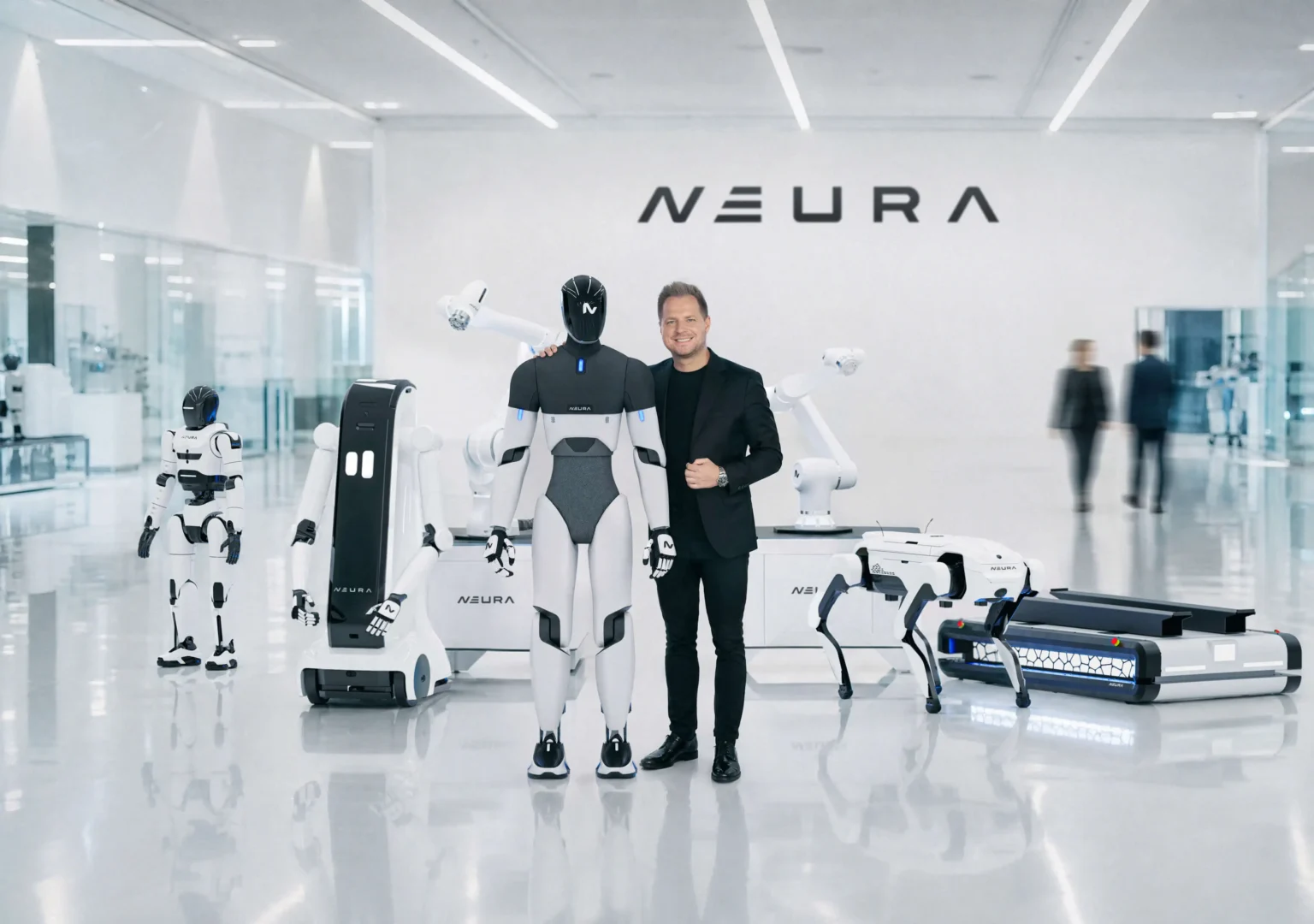
NEURA Robotics Raises Up to $1.4B as Europe Pushes Physical AI Toward Scale
NEURA Robotics announced a Series C financing round of up to $1.4 billion on June 10, 2026, positioning the German company as one of the strongest European players in the emerging Physical AI and humanoid robotics race. The round includes backing from Tether, Qualcomm Technologies, Amazon, NVIDIA, imec.xpand, Bosch, Schaeffler, the European Investment Bank, Lingotto Horizon, InterAlpen Partners and others. NEURA says the capital will support the global deployment of cognitive robots and humanoids, the expansion of its Neuraverse platform, the rollout of NEURA Gyms, and the scaling of manufacturing and deployment infrastructure.
The announcement is important because it frames humanoid robotics not only as a robot-platform race, but as an infrastructure race. NEURA is not only raising money to build more robots; it is trying to build a shared Physical AI ecosystem where robots can learn, exchange capabilities and improve through real-world training environments. This fits a broader industry shift from impressive demos toward scalable deployment systems: manufacturing capacity, robot data, edge AI, partner ecosystems and customer pipelines. The company also reports an orderbook and strategic deployment pipeline exceeding $1 billion, while Financial Times reports that the round values NEURA at around $7 billion. These figures should still be interpreted carefully, because large funding rounds and orderbooks do not automatically prove large-scale deployment. However, the combination of capital, industrial partners and production ambitions makes NEURA one of the clearest June signals that Europe wants a stronger position in humanoid robotics and Physical AI.

NEURA’s Series C shows that humanoid robotics is moving beyond isolated robot prototypes toward full deployment infrastructure. The most important signal is not only the size of the round, but the ecosystem around it: investors and partners from AI compute, industrial automation, components, manufacturing and finance. For Europe, this could become a strategic counterweight to the US and China in humanoid robotics, especially if NEURA can convert funding, partnerships and orderbook claims into repeatable industrial deployments.
Sources & Further Reading:
- https://neura-robotics.com/record-series-c
- https://www.wsj.com/tech/ai/nvidia-amazon-back-neura-robotics-1-4-billion-fundraise-ff630662
- https://www.ft.com/content/237f10c2-b2b2-490b-bec1-8864e0a22772
– – – – – – – – – – – – – – – – – – – – – – – – – –
– – – – – – – – – – – – – – – – – – – – – – – – – –
Bosch, Schaeffler and Siemens Position Humanoid AI as Part of Europe’s Industrial Humanoid Robotics Ecosystem

According to Forbes, Bosch will manufacture robots for Humanoid AI using Schaeffler components. This is an important development not only for Humanoid AI, but also for the broader European industrial robotics landscape. The partnership connects a young UK-based humanoid robotics company with three of Europe’s strongest industrial players: Bosch, Schaeffler and Siemens.
Humanoid AI was founded in 2024 and is still an early-stage company, but it is already addressing one of the central questions in humanoid robotics: how can robots move from prototypes to scalable, safe and useful systems for real industrial environments? The company’s HMND 01 Alpha robot has already been tested by Siemens in its Electronics Factory in Erlangen for logistics tasks such as picking, transporting and placing totes.
The reported Siemens trial results are notable because they focus on operational metrics rather than only a visual demonstration. Siemens reported 60 tote movements per hour, more than eight hours of uptime and over 90% autonomous pick-and-place success. These figures should still be treated as pilot-stage results, but they provide a more concrete signal than many humanoid robotics announcements.
The partnership structure creates a clear division of industrial roles. Bosch brings manufacturing, industrialization, quality management and supply-chain capability. Humanoid AI contributes the robot platform and Physical AI vision. Schaeffler adds motion technology, precision components and actuator expertise, while also representing a potential large-scale industrial user through its own manufacturing network. Siemens adds the automation and factory-integration layer, including digital twins, simulation and industrial software.
This makes the news significant beyond a single company partnership. Humanoid robotics is increasingly becoming an ecosystem challenge, not only a single-product race. Building a useful humanoid robot requires more than a promising prototype: it requires manufacturable hardware, reliable components, factory integration, safety validation, deployment data and customers willing to test robots in real operations.
For Europe, this type of collaboration may be strategically important. While the United States and China currently dominate much of the humanoid robotics conversation, Europe has deep strengths in industrial automation, manufacturing systems, motion technology and factory software. A Bosch–Schaeffler–Siemens–Humanoid AI structure shows how these strengths could be combined into a European industrial humanoid robotics ecosystem.
This partnership shows that the future of humanoid robots will not only depend on who builds the most impressive robot. It will depend on who can make humanoids reliable, affordable, safe, manufacturable and useful in real industrial operations. The combination of Bosch, Schaeffler, Siemens and Humanoid AI is therefore best understood as an industrialization signal, not only a robotics headline.
Sources & Further Reading:
- https://www.forbes.com/sites/johnkoetsier/2026/05/21/humanoids-new-deal-bosch-will-build-its-robots-with-schaeffler-parts
- https://press.siemens.com/global/en/pressrelease/siemens-and-humanoid-bring-physical-ai-factory-floor-deploying-humanoids-industrial
- https://www.reuters.com/business/british-tech-company-humanoid-targets-us-ipo-by-2030-2026-05-13
– – – – – – – – – – – – – – – – – – – – – – – – – –
– – – – – – – – – – – – – – – – – – – – – – – – – –
NVIDIA, Unitree and Sharpa Turn the Humanoid Platform into a Reference Design
On 31 May 2026, ahead of COMPUTEX and GTC Taipei activity, NVIDIA announced the Isaac GR00T Reference Humanoid Robot, an open reference design intended to help researchers and developers build generalist humanoid systems. The design combines Unitree’s humanoid body, Sharpa’s dexterous robotic hands and NVIDIA’s Jetson Thor compute platform with the Isaac GR00T software stack. NVIDIA said the reference humanoid robot would be available from Unitree in late 2026, while a GR00T reference workflow for the Unitree G1 was expected to become available on GitHub and Hugging Face for developers. Reuters later reported that NVIDIA also planned to work with humanoid robot makers in the United States, Europe and South Korea, not only with Unitree, and that the research robots were intended for academic users including Stanford University and UC San Diego.
This update is important because it shifts the platform discussion from isolated robot demos to shared development infrastructure. NVIDIA is not presenting itself as a complete humanoid manufacturer; instead, it is trying to define a compute, software and workflow layer that other robot makers can build around. The Unitree-Sharpa-NVIDIA structure also shows how the humanoid stack is becoming modular: body, hands, onboard compute, simulation, model training and security are increasingly supplied by different actors. The commercial impact remains early because availability is planned for late 2026, but the strategic signal is strong: humanoid development may accelerate through reference architectures rather than every company building a fully isolated stack.
This item helps separate deployment infrastructure from promotional demonstrations. A reference robot does not prove mass commercial adoption, but it can reduce friction for universities, labs and developers that need standardized hardware for embodied AI research. If widely adopted, it could also make benchmarking, model transfer and component comparison more practical.
Sources & Further Reading:
- https://nvidianews.nvidia.com/news/nvidia-open-humanoid-robot-reference-design
- https://www.reuters.com/world/asia-pacific/nvidia-work-with-us-european-humanoid-robot-makers-addition-chinas-unitree-2026-06-01
- https://www.wired.com/story/nvidia-unitree-humanoid-robot-h2-plus
– – – – – – – – – – – – – – – – – – – – – – – – – –
– – – – – – – – – – – – – – – – – – – – – – – – – –
LinkerBot Targets $6B Valuation as Dexterous Hands Emerge as a Key Bottleneck in Humanoid Robotics
As humanoid robotics moves from stage demonstrations to early industrial deployment, one technical bottleneck is becoming increasingly visible: the hand. Walking, balancing, and full-body motion still dominate public attention, but the commercial value of humanoid robots will ultimately depend on whether they can manipulate the physical world with reliability, precision, and adaptability.
This is why LinkerBot, also known through its Chinese company name Lingxin Qiaoshou (Beijing) Technology Co., Ltd., deserves closer attention. The company develops the Linker Hand series of dexterous robotic hands and positions itself around an embodied intelligence platform built on “dexterous hands + cloud-based intelligent brains.” According to 36Kr, Lingxin Qiaoshou completed a seed financing round of more than 100 million yuan in 2025, led by Sequoia China Seed Fund and Wankai New Materials. Separately, Reuters later reported that LinkerBot had completed a Series B+ round at a $3 billion valuation and was targeting a possible $6 billion valuation in its next financing round.
The important point is not only the size of the financing, but the strategic focus. LinkerBot is not trying to win the humanoid race by building a complete robot. It is trying to dominate one of the most difficult and valuable components of the humanoid stack: the hand.
For humanoid robots, dexterity is not a secondary feature. It is the difference between a robot that can move through a factory and a robot that can actually perform useful work inside it. A humanoid may walk well, recognize objects, and navigate safely, but if it cannot grasp, rotate, insert, tighten, sort, or handle fragile objects, its practical deployment remains limited. Many industrial tasks require more than simple gripping. They require force control, finger coordination, tactile response, object adaptation, and repeatable precision.
The technical specifications behind Linker Hand show why this area matters. According to 36Kr, the industrial version of the Linker Hand series reaches 25–30 degrees of freedom, while the research version reaches up to 42 degrees of freedom. Each finger can have up to 9 degrees of freedom and rotate 360 degrees. The full-drive design, combined with a force-position hybrid control algorithm, allows a maximum load of 5 kg. 36Kr compares this with the Shadow Hand at 24 degrees of freedom and the Tesla Optimus hand at 22 degrees of freedom.
Cost is another important part of the story. The Linker Hand is reported to cost around 50,000 yuan per unit, while the Shadow Hand is cited at around 1.5 million yuan. The Linker Hand O7 lowers the entry price further to 8,800 yuan. For research, education, industrial automation, and embodied AI development, this price difference is significant because it lowers the threshold for experimentation and large-scale deployment. 36Kr also states that Linker Hand durability is 10 times that of Shadow Hand according to official test data, and that the company offers a “replace instead of repair” service to reduce downtime for users.
From a market perspective, LinkerBot represents a different model from full-stack humanoid companies such as Tesla, Figure AI, Boston Dynamics, Agility Robotics, Unitree, AgiBot, UBTech, and Apptronik. Instead of building the whole robot, it focuses on component-level specialization. As the humanoid sector matures, some firms will compete through complete platforms, while others may dominate critical subsystems such as actuators, robotic hands, batteries, perception modules, control software, and embodied AI datasets.
This also reflects a broader trend in China’s robotics ecosystem: the shift from full robot competition to supply-chain depth. Chinese humanoid companies already compete strongly on hardware cost, manufacturing speed, and iteration cycles. The next stage may be less about which company builds the most impressive demo and more about which ecosystem can produce the necessary components at scale. Dexterous robotic hands are a strong example because they combine mechanical design, motors, reducers, joint modules, lightweight materials, sensors, control systems, and manipulation data.
The data layer is equally important. Dexterous manipulation is not only a hardware problem; it is also an AI and learning problem. Robotic hands do not become useful simply by having many degrees of freedom. They need control policies, task demonstrations, multimodal data, and reusable skill libraries that allow them to perform complex actions consistently. LinkerBot’s approach connects dexterous hands with embodied AI through platforms such as motion-capture teleoperation systems, digital twin platforms, and manipulation datasets.
The valuation discussion should therefore be interpreted carefully. The 100 million yuan figure refers to the earlier seed financing reported by 36Kr, not to the company’s valuation. The $3 billion and potential $6 billion figures come from later Reuters reporting on LinkerBot’s Series B+ and next financing target. Together, these figures show how quickly investor attention has moved toward dexterous manipulation as a strategic layer in robotics.
The industry implication is clear: the humanoid robotics race is no longer only a competition between complete robot makers. It is also a competition between component suppliers, data platforms, manufacturing ecosystems, and deployment strategies. If humanoid robots are to become useful in factories, logistics, services, and eventually homes, they will need hands that can perform real work. That makes dexterous manipulation one of the most important bottlenecks in the industry.

Linker Hand series of dexterous hands (Source/Enterprise)
From Full Humanoids to Component Specialization
The humanoid robotics industry is often discussed through the lens of full-stack companies such as Tesla, Figure AI, Boston Dynamics, Agility Robotics, Unitree, AgiBot, UBTech, and Apptronik. LinkerBot represents a different but increasingly important model: component-level specialization. As the sector matures, some firms will build complete platforms while others dominate critical subsystems. In humanoid robotics, these strategic categories may include actuators, hands, batteries, perception modules, control software, and embodied AI datasets.
China’s Component Advantage
LinkerBot also reflects a broader trend in China’s robotics ecosystem: the move from full robot competition to supply-chain depth. Chinese humanoid companies already compete aggressively on hardware cost, speed of iteration, and manufacturing scale. The next stage may be less about which company builds the most impressive demo and more about which ecosystem can manufacture the necessary components at scale. Dexterous robotic hands are a strong example because they combine mechanical design, motors, reducers, joint modules, lightweight materials, control systems, and manipulation data.
The Data Layer: Dexterity as an AI Problem
The hardware story is only one part of the picture. Dexterous manipulation is also a data and learning problem. Robotic hands do not become useful simply by having many degrees of freedom. They need control policies, task demonstrations, multimodal data, and reusable skill libraries that allow them to perform complex actions consistently. This is where dexterous hands connect directly to embodied AI; the next generation of humanoid robots will need models that understand contact, force, motion, object behavior, and task sequencing.
Why the Valuation Matters
A $6 billion valuation target is ambitious, especially for a market that remains early. Humanoid robots are not yet deployed at mass scale, and many pilot projects remain limited. However, LinkerBot’s model may reduce some of that risk because its products are not limited to complete humanoids. Dexterous hands can be used in research, industrial automation, robotic arms, teleoperation, embodied AI training, and specialized manufacturing tasks. The valuation therefore signals that the market is beginning to price dexterous manipulation as a strategic layer in robotics, not merely as a mechanical accessory.
Industry Implication
The LinkerBot story shows that the humanoid robotics race is becoming more complex. It is no longer only a competition between complete robot makers. It is also a competition between component suppliers, data platforms, manufacturing ecosystems, and deployment strategies. If humanoid robots are to become useful in factories, logistics, services, and eventually homes, they will need hands that can perform real work. That makes dexterous manipulation one of the most important bottlenecks in the industry.
Sources & Further Reading:
- https://www.reuters.com/world/china-robot-hand-building-unicorn-linkerbot-targets-6-billion-valuation-2026-05-04
- https://www.wired.com/story/made-in-china-the-dollar6-billion-chinese-startup-making-hands-for-humanoids
- https://eu.36kr.com/en/p/3239621788565507
- https://beststartup.asia/linkerbot-chinas-dexterous-robot-hands-unicorn
– – – – – – – – – – – – – – – – – – – – – – – – – –
– – – – – – – – – – – – – – – – – – – – – – – – – –
XDOF emerges from stealth and releases ABC-130K robot manipulation dataset
On June 17, 2026, California-based robotics data infrastructure startup XDOF emerged from stealth with $70 million in funding and released ABC-130K, an open-source bimanual robot manipulation dataset developed with researchers from UC Berkeley, MIT, Amazon FAR, Carnegie Mellon University and XDOF. XDOF describes ABC-130K as the largest open-source robot teleoperation dataset to date, with more than 130,000 episodes across 195 bimanual manipulation tasks and roughly 3,500 hours of real-world teleoperation data. The company was co-founded by Philipp Wu, Yide/Fred Shentu and Nemo Jin, and focuses on building the data pipelines, collection tools, annotation systems and training infrastructure needed for robot foundation models. XDOF is not a humanoid robot manufacturer; it operates as an infrastructure provider for companies and labs trying to train robots for real-world physical tasks. According to TechCrunch, the company has about 60 employees and around 20 customers, including several frontier AI labs, although it has not publicly named those customers. The released stack also includes simulation teleoperation data, training code, hardware setup details and evaluation infrastructure. The tasks include pick-and-place, folding, handover, insertion, tool use and assembly, with reported real-world evaluations on dexterous manipulation tasks such as folding boxes and extracting credit cards from wallets.

The announcement matters because it shows that embodied AI is becoming a data infrastructure race, not only a robot hardware or model architecture race. Humanoid robotics companies need large volumes of high-quality physical interaction data to train manipulation policies that can generalize beyond demos. Although ABC-130K is not humanoid-specific, its bimanual manipulation focus is directly relevant to humanoid deployment, where hands, perception, contact timing and task variation must work together. The key limitation is that open datasets alone do not solve safety, reliability or factory-readiness. Still, XDOF’s launch suggests that robot data pipelines, teleoperation systems, annotation workflows and real-world evaluation may become a competitive moat for physical AI.
Sources & Further Reading:
- https://techcrunch.com/2026/06/17/collecting-robot-training-data-is-dirty-unglamorous-work-some-ai-labs-are-already-paying-xdof-to-do-it
- https://abc.bot
- https://siliconangle.com/2026/06/17/robotic-teleoperation-data-startup-xdof-launches-70m-funding
– – – – – – – – – – – – – – – – – – – – – – – – – –
– – – – – – – – – – – – – – – – – – – – – – – – – –
NVIDIA Halos Brings Safety Infrastructure to Humanoid and Industrial Robots
On June 22, 2026, NVIDIA announced NVIDIA Halos for Robotics, a full-stack safety system for robotics and Physical AI. The system extends NVIDIA’s safety work from autonomous vehicles into robots that sense, decide and act in real-world environments. NVIDIA describes Halos for Robotics as a unified architecture combining AI compute, sensor processing, system software, safety applications and inspection technologies. The announcement was made around Automate 2026 in Chicago, where NVIDIA positioned safety as a core requirement for industrial robots, humanoids and physical AI systems moving closer to human workspaces.
Agility Robotics was named as the first humanoid robotics company to integrate elements of NVIDIA Halos into its Digit robots, which are being developed for factories, warehouses and logistics operations with customers including Amazon, GXO, Schaeffler and Toyota Motor Manufacturing Canada. This is important because Digit is not only a research platform; it is being positioned for real industrial environments where human-robot proximity, uptime, repeatability and safety validation matter. NVIDIA’s approach also signals that humanoid robotics safety is becoming a platform-level problem rather than a feature added at the end of development.
This announcement matters because humanoid robot deployment will depend heavily on safety infrastructure. Industrial customers are unlikely to scale humanoid robots only because they can walk, lift or grasp. They will need evidence that the robots can operate predictably around people, machines and changing factory conditions. Halos therefore fits a broader shift in the sector: from isolated demonstrations toward deployable systems with compute, perception, validation, safety monitoring and certification pathways.
Sources & Further Reading:
- https://nvidianews.nvidia.com/news/nvidia-announces-halos-for-robotics-the-industrys-first-full-stack-safety-system-for-physical-ai
- https://investor.nvidia.com/news/press-release-details/2026/NVIDIA-Announces-Halos-for-Robotics-the-Industrys-First-Full-Stack-Safety-System-for-Physical-AI/default.aspx
- https://www.nvidia.com/en-us/ai-trust-center/halos/robotics
- https://www.axios.com/2026/06/22/nvidia-humanoid-ai-robotics
– – – – – – – – – – – – – – – – – – – – – – – – – –
– – – – – – – – – – – – – – – – – – – – – – – – – –
Automate 2026 Signals Humanoids’ Entry into Mainstream Industrial Automation
Automate 2026 took place from June 22 to June 25, 2026, at McCormick Place in Chicago. The event brought together robotics, AI, machine vision, motion control and industrial automation companies, but the strongest humanoid robotics signal came from the dedicated Humanoid Robot Forum and NVIDIA-sponsored Humanoid Robot Pavilion. NVIDIA framed the event around Physical AI, humanoid robots, vision AI, digital twins and industrial automation, showing how simulation, synthetic data, edge AI and factory operations are increasingly being discussed as one connected deployment stack.
The event is important because it shows that humanoid robotics is becoming part of mainstream industrial automation rather than remaining only a research or viral-demo category. The discussion around humanoids at Automate was not only about robot appearance or movement. It was about how robots can be integrated into manufacturing and logistics environments, how safety can be validated, how simulation can support deployment, and how companies can move from pilot projects toward repeatable operations.

Image: Automate 2026
For the monthly report, Automate 2026 should be read as an ecosystem signal. Humanoid robots still face major technical and economic barriers, but their presence at a major industrial automation event shows that suppliers, integrators, chip companies, software providers and end users are beginning to treat humanoids as a serious industrial category. This does not prove mass adoption yet, but it does show that the conversation is shifting from “Can humanoids work?” to “What infrastructure is needed for them to work safely and economically?”
Sources & Further Reading:
- https://www.automateshow.com
- https://www.nvidia.com/en-us/events/automate-conference
- https://www.automateshow.com/a3-press-releases/automate-2026-brings-popular-humanoid-robot-forum-and-nvidia-sponsored-humanoid-robot-pavilion-to-show
- https://embeddedcomputing.com/application/industrial/automation-robotics/nvidia-sponsors-new-humanoid-robot-pavilion-at-automate-2026
- https://www.automateshow.com/education-networking/humanoid-robot-pavilion
– – – – – – – – – – – – – – – – – – – – – – – – – –
– – – – – – – – – – – – – – – – – – – – – – – – – –
Runtime-Editable Loco-Manipulation System Targets Real-World Humanoid Task Adaptation
On June 24, 2026, Duncan William Calvert published “A System for Fast, Resilient, and Adaptable Loco-Manipulation Behaviors on Humanoid Robots” on arXiv. The work focuses on one of the hardest problems in humanoid robotics: combining locomotion, whole-body motion, perception, contact and operator supervision in real-world tasks. Rather than treating walking and manipulation separately, the system supports runtime-editable behavior authoring, monitoring and repair, allowing operators to adapt robot behaviors during task execution.
The thesis combines object-centric Affordance Templates, Behavior Tree-inspired logic, runtime-editable perception and primitive scene actions. Its behavior library covers more than twenty real-robot task variants, including door opening, obstacle clearing, exploration sequences and reactive table-to-table manipulation. The system has been deployed across several humanoid platforms, including Boston Dynamics’ DRC Atlas, NASA Valkyrie, Nadia, Unitree H1-2 and IHMC Alex. The reported contribution is not a single flashy robot demo, but a reusable behavior system for creating, adapting and combining loco-manipulation behaviors more quickly.
This matters because practical humanoid deployment will require robots to handle task variation. In factories, warehouses or field environments, a robot may need to open different doors, move around obstacles, recover from perception errors, manipulate objects while walking, or respond to operator corrections. A runtime-editable system directly addresses this gap between scripted demonstrations and operational usefulness.
Sources & Further Reading:
- https://arxiv.org/abs/2606.26425
- https://www.youtube.com/playlist?list=PLJK5CTyotYqsfgfnXb-09YNFeBose6uEY
– – – – – – – – – – – – – – – – – – – – – – – – – –
– – – – – – – – – – – – – – – – – – – – – – – – – –
Turkey’s Humanoid Robotics Ecosystem Gains Momentum with DOF Robotics and AKINROBOTICS
DOF Robotics is preparing a $25 million factory investment in Istanbul to expand its production capacity for service robots and humanoid robot development. The planned DOF TECH facility will be located in the Kuzey Marmara Special Industrial Zone in Arnavutköy and is expected to increase the company’s production area from 4,000 square meters to 16,000 square meters. The new facility is planned as an integrated production site bringing together R&D, software development, automation, machining, welding, painting, assembly, electrical automation, software integration and factory acceptance testing under one roof.
The most important part of the announcement is not only the size of the investment, but the company’s stated intention to convert its accumulated R&D capability into domestic robot production. DOF Robotics Chairman Mustafa Mertcan said the company aims to transform years of R&D experience into production in Turkey and plans to begin the development and prototype manufacturing processes for humanoid robot projects at the new facility. He also stated that, with future capacity expansion, the company aims to move toward serial production and believes humanoid robots developed with Turkish engineering can take a place in global markets.
This makes the news relevant for the monthly humanoid robotics report as a regional industrial-capacity signal. DOF Robotics is not yet evidence of large-scale humanoid deployment, but the announcement shows that Turkey-based robotics companies are beginning to position themselves around the infrastructure needed for humanoid robot development: prototyping, integrated production, software integration, testing and eventual serial manufacturing. In this sense, the news fits the broader industry shift from isolated demonstrations toward deployment and manufacturing infrastructure.
DOF Robotics’ investment should be read less as a finished humanoid robot breakthrough and more as a capacity-building move. The key signal is that the company wants to use its existing R&D base to start humanoid robot development and prototype production in Turkey, with serial production as a longer-term target. For the monthly report, this supports the broader thesis that humanoid robotics is becoming a global industrial ecosystem, with new regional players trying to build manufacturing and engineering capacity beyond the dominant U.S., Chinese and European headline companies.
A related signal from Turkey also came from AKINROBOTICS, the company behind AKINCI, described as Turkey’s first humanoid robot, which introduced the AKINCI-5 humanoid robot as the next generation of its long-running AKINCI project. Unlike DOF Robotics’ announcement, which is mainly a new factory and capacity-building investment, AKINROBOTICS represents Turkey’s earliest humanoid R&D lineage, dating back to its humanoid robot work launched in 2009. Together, these developments suggest that humanoid robotics is no longer only a race led by the dominant U.S. and Chinese players, but is gradually becoming a wider global industrial field where regional companies are also trying to build their own engineering, prototyping and production capabilities.

Image: AKINCI-5
Sources & Further Reading:
- https://www.cnbce.com/borsa/25-milyon-dolarlik-yatirim-insansi-robot-fabrikasi-kuruluyor-h31701
- https://kap.org.tr/tr/sirket-bilgileri/genel/6130-dof-robotik-sanayi-a-s
- https://www.ekonomim.com/sirketler/dof-roboticsten-25-milyon-dolarlik-yatirim-turk-muhendisligiyle-insansi-robot-uretimine-hazirlaniyor-haberi-900211
- https://www.yuzde100yerli.com/en/akinrobotics-unveils-humanoid-robot-akinci-5-robots-fluid-gait-draws-attention
– – – – – – – – – – – – – – – – – – – – – – – – – –
– – – – – – – – – – – – – – – – – – – – – – – – – –
Agility Robotics’ $2.5B SPAC Deal Brings Humanoid Deployment to Public Markets
On June 24, 2026, Agility Robotics announced plans to go public through a merger with Churchill Capital Corp XI. The transaction is expected to create a publicly listed U.S. pure-play humanoid robotics company and values Agility at approximately $2.5 billion. The combined company is expected to trade under the ticker AGLT after the transaction closes, subject to approvals and customary closing conditions. Agility says the deal is intended to support the scale-up of Digit v5, its bipedal humanoid robot designed for logistics, material handling and repetitive industrial tasks.
The announcement is significant because Agility is one of the clearest examples of a humanoid company trying to move from pilots toward commercial deployment. Digit has been associated with customers and partners including GXO, Schaeffler, Toyota and Amazon-related logistics environments. The company’s pitch is not only that humanoids can perform impressive movements, but that a bipedal robot can be integrated into existing warehouses and factories built for human workflows.
The SPAC structure should still be interpreted carefully. Public-market access does not automatically prove technology maturity, profitability or large-scale adoption. However, the deal shows that humanoid robotics is beginning to attract a different kind of capital-market attention. NEURA’s large private financing and Agility’s planned public listing together suggest that investors are increasingly treating humanoid robotics as an emerging industrial category rather than a distant research theme.
Sources & Further Reading:
- https://www.agilityrobotics.com/content/agility-robotics-to-go-public-through-merger-with-churchill-capital-corp-xi
- https://www.reuters.com/legal/transactional/agility-robotics-go-public-25-billion-spac-deal-wsj-reports-2026-06-24
- https://www.businessinsider.com/agility-robotics-spac-merger-go-public-2-5-b-valuation-2026-6
- https://www.barrons.com/articles/robot-maker-agility-robotics-spac-merger-ddb4fc3b


Leave a Reply