
Unitree Robotics Soars 460% in Shanghai STAR Market Debut
Unitree Robotics made a striking debut on Shanghai’s STAR Market, underscoring strong investor enthusiasm for China’s humanoid robotics sector. Founded in 2016 by entrepreneur Wang Xingxing in Hangzhou, the company raised approximately 6.1 billion yuan ($904 million) through its IPO on the Shanghai Stock Exchange’s Nasdaq-style technology board.

Image: Unitree
Unitree priced its shares at 150.80 yuan ($22.36) each, but investor demand drove the stock sharply higher on its first trading day. The shares closed at 845 yuan ($125.31), representing a 460% gain from the IPO price and valuing the company at a substantial premium to its listing level.
The blockbuster debut is significant for the broader humanoid robotics industry. It signals that public-market investors are increasingly willing to assign high valuations to robotics companies with commercially available products.
More broadly, the listing marks an important milestone for the humanoid robotics sector as companies begin transitioning from private-market valuations to being priced by public investors. Unitree is particularly notable because a significant share of its revenue already comes from actual robot sales rather than purely experimental projects. Proceeds from the IPO are expected to support further R&D and manufacturing expansion, which could intensify price competition across China’s rapidly growing robotics market. The successful listing may also serve as a precedent for other Chinese robotics companies, including AgiBot, Leju, Deep Robotics, and Galbot, as they consider their own potential public-market plans.
Sources & Further Reading:
- https://www.reuters.com/world/asia-pacific/chinese-humanoid-robot-maker-unitree-set-jump-over-600-shanghai-debut-2026-08-19
- https://apnews.com/article/china-robots-unitree-ipo-shanghai-f33facc61122faf0c0b08af5020bd170
- https://www.marketwatch.com/story/unitrees-ipo-may-be-just-the-beginning-of-an-investor-frenzy-over-humanoid-robot-stocks-8c2d39b6
– – – – – – – – – – – – – – – – – – – – – – – – – –
– – – – – – – – – – – – – – – – – – – – – – – – – –
Schaeffler Tackled a Critical Bottleneck in Humanoid Joint Costs
Schaeffler unveiled its formed strain-wave gearbox technology, developed specifically for humanoid robot joints. The key innovation is that the gearbox’s high-precision components are produced using a forming process, drawing on Schaeffler’s automotive manufacturing expertise, rather than relying primarily on conventional precision machining.
In the traditional approach, the required high-precision tooth geometry is created by cutting and machining material away. Schaeffler’s method instead uses high forming forces to shape the component directly into the required geometry. According to the company, this can reduce production time for critical components from minutes to seconds, while still delivering high dimensional accuracy and process stability and maintaining torque and efficiency levels comparable to conventionally machined strain-wave gearboxes and strain wave gear reactors boast a high level of precision, zero backlash and a very good weight/torque ratio.

Image: Schaffler
Schaeffler is not developing this approach from scratch; the company has used similar forming know-how in automotive strain-wave gearbox production for years and has manufactured more than 2 million formed strain-wave gearboxes over the past decade. It is now adapting that high-volume automotive manufacturing expertise to humanoid robot joints.
The company says the new manufacturing method can reduce gearbox production costs by more than 25% and material consumption by more than 75%. Series production for multiple global humanoid robot manufacturers is planned to begin in 2027.
This is, in my view, one of the most important hardware developments of the month. In a humanoid robot’s BOM, the combination of high-precision gearbox + motor + encoder + bearing + controller is among the most expensive subsystems. If Schaeffler can preserve the cost advantage it claims at mass-production scale, it could create significant pricing pressure in the harmonic/strain-wave transmission market.
Schaeffler had also previously reached an agreement with Hexagon Robotics to supply rotary actuators and gearboxes, while announcing plans to deploy at least 1,000 humanoid robots in its own factories over the coming years. This means the company is positioning itself not only as a component supplier, but also as a major deployment customer for humanoid robotics.
Sources & Further Reading:
- https://www.schaeffler.de/de/news_medien/pressemitteilungen/pressemitteilungen_detail.jsp?id=88184987
- https://www.schaeffler-industrial-drives.com/en/news_media/press_releases/press_releases_detail.jsp?id=8821024
– – – – – – – – – – – – – – – – – – – – – – – – – –
– – – – – – – – – – – – – – – – – – – – – – – – – –
Beyond the Robots: China Is Building a Full-Stack Humanoid Supply Chain
The World Robot Conference 2026 offered one of the clearest snapshots yet of how quickly China’s robotics industry is expanding beyond individual humanoid prototypes into a broader industrial ecosystem.
Held in Beijing from August 19 to 23, the conference brought together 373 exhibitors and more than 3,000 robotic products, including 311 new product launches. The scale of the event was notable, but the more important signal was what was happening underneath the finished robots: China is developing an increasingly deep and specialized humanoid supply chain.
Some of the country’s most prominent robotics companies appeared side by side.
UBTECH showcased the Walker C1, targeting service and industrial applications. Fourier Intelligence presented the GR-3, a soft-skin humanoid designed around care, education and human interaction. Leju Robotics demonstrated its KUAVO humanoid, while Galbot showed its wheeled G1 platform for logistics and warehouse tasks.
LimX Dynamics brought Luna, highlighting approaches that allow robots to acquire behaviors from human demonstrations and video. Robotera demonstrated the L7 for logistics and manufacturing applications. Unitree, meanwhile, continued to draw attention with its lower-cost R1 humanoid and high-agility demonstrations. Reuters highlighted many of the same companies as representative of the breadth of China’s robotics sector at this year’s conference. But comparing specifications between individual robots may miss the larger story.

China’s humanoid industry is increasingly becoming horizontally specialized.
Instead of every robot manufacturer developing the entire technology stack internally, an ecosystem is emerging in which different companies specialize in actuators, motors, gearboxes, dexterous hands, force and vision sensors, controllers, batteries, AI models and complete humanoid platforms.
That changes the economics of building a humanoid robot.
A new robotics company no longer necessarily needs to develop every joint, motor, hand, battery system and controller from scratch. It can increasingly source specialized components from an expanding domestic supplier base and concentrate its engineering resources on integration, software, embodied intelligence or a particular application.
The result is a more modular industry.
This resembles an earlier stage in the development of the PC, smartphone and electric-vehicle industries, where specialized suppliers gradually turned previously proprietary technologies into accessible industrial building blocks. Once that happens, development cycles can shorten, component volumes can increase and costs can fall across the entire sector.
The conference also showed that China’s robotics companies are increasingly competing around applications rather than demonstrations alone. Logistics, manufacturing, healthcare, education, retail and service environments featured prominently across the exhibition. Chinese officials and companies have similarly emphasized moving robots from showcases into commercial deployment.
That does not mean humanoid robotics has already reached mass adoption. Many systems remain expensive, highly constrained or dependent on controlled environments, and reliable autonomous operation in complex real-world settings remains a major technical challenge.
But WRC 2026 suggests that another important threshold may already be approaching.
The race Is increasingly about who can build the industrial ecosystem that allows thousands of companies to build one.
And on that front, China’s emerging advantage may lie less in any single robot on the exhibition floor than in the supply chain forming around all of them.
Sources & Further Reading:
- https://www.reuters.com/world/asia-pacific/beyond-marathons-backflips-chinas-robots-face-commercial-test-2026-08-18
- https://www.reuters.com/world/asia-pacific/china-robot-makers-flock-beijing-show-seek-path-mass-adoption-2026-08-19
- https://www.reuters.com/world/asia-pacific/chinese-companies-watch-world-robot-conference-2026-08-20
– – – – – – – – – – – – – – – – – – – – – – – – – –
– – – – – – – – – – – – – – – – – – – – – – – – – –
World Humanoid Robot Games 2026
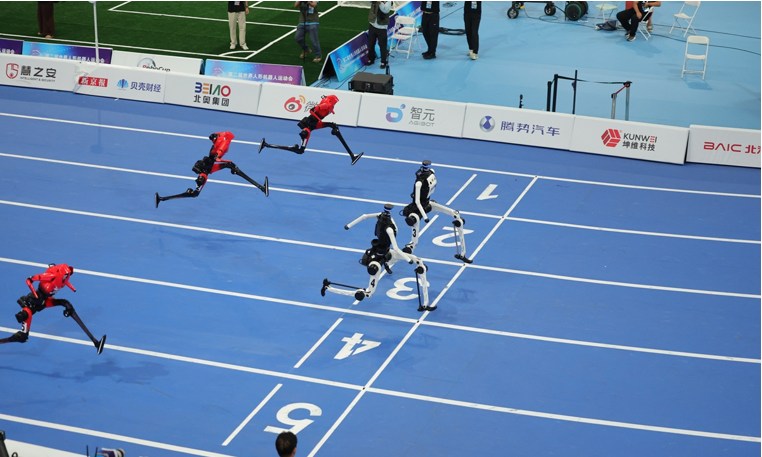
The second World Humanoid Robot Games, held in Beijing between August 22-26, concluded with 666 teams, 2,056 robots, and participants from 16 countries. Over five days, a total of 1,301 matches were held across 51 different events. Of these, 30 were athletic and competitive events, while 21 focused on testing robots in real-world application scenarios. The scenario-based competitions covered industrial production, hotel service, household tasks, emergency rescue, healthcare, retail, and other practical environments. According to official statements from the organizers, these tasks were designed to evaluate robots not only in terms of mobility, but also across perception, manipulation, planning, balance, and autonomous decision-making. The most visible progress came on the locomotion side. Tiangong Ultra, developed by the Beijing Humanoid Robot Innovation Center, had already attracted attention by running the 100-meter preliminary heat in 9.39 seconds, but it continued to improve throughout the competition and completed the final in 8.64 seconds. This represented a dramatic improvement compared with the 21.50-second result recorded at the same event in 2025. Previous records were also improved by large margins in disciplines such as the 400 meters, 1,500 meters, and standing high jump.

The large group 100-meter sprint match on the 2nd World Humanoid Robot Games on August 26, 2026. Photo: Li Hao/GT
However, from an industry perspective, the more important developments emerged from the scenario-based competitions rather than the sprint events. In supermarket tasks, for example, robots had to perceive products, pick them up, transport them, and place them on shelves. In industrial scenarios, they were required to perform assembly and manipulation tasks, while emergency-response challenges demanded that robots perceive their surroundings and complete longer sequences of actions. Unlike controlled laboratory demonstrations, these competitions increasingly evaluate locomotion + perception + manipulation + autonomous planning within the same task chain.
Another significant outcome of the competition came on the data generation side. At the closing ceremony, organizers released the World Humanoid Robot Games full dataset to the public free of charge, describing it as the first dataset of this scale generated through such an event. This moves the competition beyond simply comparing robot performance and turns it into a potential data-generation infrastructure for training and evaluating embodied-AI models.
For this reason, it is becoming increasingly inadequate to view the World Humanoid Robot Games simply as a technology showcase. The event is not yet a fully standardized and independent benchmark comparable to ImageNet, KITTI, or established academic robotics benchmarks, but it is increasingly becoming a large-scale testing platform where humanoid robots can be compared across speed, stability, dexterity, manipulation, autonomy, and real-world task execution in a common environment. The most important message from the 2026 competition is therefore clear: the humanoid robotics race is shifting from the question of “Which robot can run faster?” toward the much more important question of “Which robot can autonomously and reliably complete a real-world task?”.
Sources & Further Reading:
- https://english.beijing.gov.cn/beijinginfo/sci/latesttrends/202608/t20260825_4836357.html
- https://www.globaltimes.cn/page/202608/1369085.shtml
- https://www.beijing.gov.cn/fuwu/lqfw/gggs/202608/t20260827_4839300.html
- https://www.bjwmb.gov.cn/wmdt/cyq/10134570.html
- https://www.beijing.gov.cn/fwcj/calendar/tyss/6a7098af21f2a033ca99bc8c.html
LG + NVIDIA: The “Robot Foundation Model + Factory Data” Model Is Expanding to Major Industrial Companies
LG Electronics is expanding its robotics collaboration with NVIDIA by combining decades of manufacturing and logistics expertise with NVIDIA’s physical-AI and robotics stack. At LG’s new Data Factory, currently being built at its Yangjae R&D Campus in Seoul, robots will collect physical interaction data from replicated home environments, simulated manufacturing spaces, logistics operations, and robotic-hand training setups. This data will then be linked with NVIDIA technologies including Isaac, Omniverse, and Cosmos, where it can be augmented and synthesized into higher-quality training data for robot learning. LG describes this process as building a “data flywheel” in which continuously collected real-world and synthetic data is repeatedly used to train and improve robots.
LG has also designated 2026 as the starting point of its broader robotics push and established a dedicated Robotics Business Center, reporting directly to the CEO, to bring together business development, sales, supply-chain activities, manufacturing, and commercialization. The company is expanding its robotics portfolio beyond industrial and commercial applications toward home robotics, with the longer-term goal of becoming a comprehensive robotics solutions provider spanning robots, core components, and data infrastructure.
The broader significance is that an approach already visible across the embodied-AI ecosystem is now spreading deeper into large industrial companies: robot hardware + foundation models + large-scale physical data + simulation + continuous deployment. Google DeepMind is pursuing similar physical-AI development through research partnerships with Apptronik and Boston Dynamics, while NVIDIA’s Isaac GR00T ecosystem combines robot foundation models, real and synthetic data, simulation, training, evaluation, and deployment tools in a unified stack.
As a result, competition in embodied AI is increasingly becoming “Who can build the largest, highest-quality, continuously improving physical-world dataset?”
Sources & Further Reading:
- https://www.lg.com/global/newsroom/news/corporate/lg-electronics-accelerates-robotics-collaboration-with-nvidia/
- https://www.lgcorp.com/media/release/30469
- https://www.lg.com/global/newsroom/news/corporate/lg-electronics-establishes-robotics-business-center-to-accelerate-future-growth/
- https://deepmind.google/models/gemini-robotics/
– – – – – – – – – – – – – – – – – – – – – – – – – –
– – – – – – – – – – – – – – – – – – – – – – – – – –
ACE Robotics: Real-World Robot Data Is Emerging as a Bigger Bottleneck
ACE Robotics, backed by Ant Group and SenseTime, has outlined an aggressive data strategy for humanoid robotics and embodied AI. Chairman Wang Xiaogang, also a co-founder of SenseTime, predicts that robot “brains” could experience a ChatGPT-like breakthrough by the end of 2027. The company is developing embodied-AI systems that bring together perception, multimodal understanding, physical-world simulation, and action planning to enable robots to understand and operate in real-world environments.
The more important figures, however, concern data. ACE estimates that the entire embodied-AI industry has accumulated only around 100,000 hours of real-world physical or manipulation data, which Wang identifies as one of the key constraints on further progress. To address this shortage, ACE is deploying lightweight sensing systems in real working environments, including production lines, and aims to collect tens of millions of hours of real-world data within the next two years. The strategy reflects ACE’s broader “human-centric” data-acquisition approach, in which human interaction with the physical world is captured at scale and then used to train world models and embodied-AI systems.
ACE’s open-source Kairos 4B model family is also being positioned as a major part of this strategy. The company says Kairos has achieved leading results across embodied-AI benchmarks covering areas such as bimanual manipulation, long-horizon task planning, physical interaction reasoning, and action prediction. Its latest open-source releases include 4-billion-parameter models capable of executable action prediction for benchmarks such as RoboTwin 2.0 and LIBERO-Plus.
The broader implication is that competition among players such as Figure/Helix, NVIDIA GR00T, Google Gemini Robotics, Physical Intelligence’s π models, Skild AI, and emerging Chinese embodied-AI companies is increasingly shifting toward data-acquisition infrastructure. I think it seems that Model architecture and parameter and acquiring continuously the largest volume of high-quality, diverse physical-world interaction data will be key topic and ACE’s strategy is a particularly explicit example of this shift.
Sources & Further Reading:
- https://www.reuters.com/technology/ace-robotics-ceo-says-robot-brains-will-have-chatgpt-moment-by-end-2027-2026-08-21/
- https://www.sensetime.com/en/news/51170534
- https://sensetime.com/en/news/51170266
- https://huggingface.co/ACERobotics/kairos-4B-robot-RoboTwin2.0
- https://www.globenewswire.com/news-release/2026/07/22/3331095/0/en/ace-robotics-unveils-kairos-world-model-with-record-performance-on-four-global-benchmarks.html
- https://www.computerweekly.com/news/366649472/ACE-Robotics-takes-aim-at-embodied-AIs-data-problem
– – – – – – – – – – – – – – – – – – – – – – – – – –
– – – – – – – – – – – – – – – – – – – – – – – – – –
U.S. Robot Import Restrictions Take on a Broader Industrial-Policy Dimension
On August 6, U.S. Federal Communications Commission Chairman Brendan Carr said that recently introduced restrictions on foreign-produced robots and connected power inverters are intended not only to address national-security concerns, but also to accelerate domestic manufacturing and encourage companies to shift investment and production capacity to the United States. Carr said the policy is designed to prevent the U.S. from becoming dependent on large numbers of potentially vulnerable foreign-made connected devices while simultaneously strengthening domestic supply chains.
The underlying measure had been announced on July 28, when the FCC added foreign-produced advanced robotic devices to its Covered List. The category includes humanoid robots, quadrupeds, autonomous mobile robots, and other wheeled or tracked robotic platforms. New covered models generally cannot obtain FCC equipment authorization and therefore cannot be newly imported, marketed, or sold in the United States unless they receive an applicable government approval. Previously authorized models are not automatically removed from the market, which is an important distinction.
Although the rules formally apply to foreign-produced advanced robotic devices rather than to any single country, their broader significance lies in how they may reshape access to robotics hardware in the U.S. market.
Sources & Further Reading:
- https://www.reuters.com/world/fcc-chair-says-robot-import-restrictions-aim-boost-us-production-2026-08-06/
- https://www.sidley.com/en/insights/newsupdates/2026/08/fcc-adds-all-foreign-produced-advanced-robotic-devices-to-the-covered-list
- https://www.fenwick.com/insights/publications/fcc-bans-new-foreign-produced-advanced-robotic-devices-and-power-inverters
- https://apnews.com/article/c9f5e3c94d91d00eff3b61b141fab366
- https://www.intertek.com/blog/2026/08-06-fcc-expands-the-covered-list-for-foreign-produced-robotic-devices/
– – – – – – – – – – – – – – – – – – – – – – – – – –
– – – – – – – – – – – – – – – – – – – – – – – – – –
Bosch to Begin Humanoid Robot Production in Bühl in 2027
Bosch is entering humanoid robot manufacturing through a partnership with UK-based robotics startup Humanoid. The company plans to begin assembling and producing Humanoid’s HMND 01 robots at its Bühl plant in Germany from 2027, with initial production expected to reach several hundred units.
Bosch will not develop the humanoid platform itself, but will act as an industrialization and manufacturing partner, bringing its experience in large-scale production, quality control, supply chains, and factory automation. The two companies are also evaluating the use of Bosch actuators, motors, sensors, and other components in future robot production.

Figure: Humanoid
The move is so significant because it marks Bosch’s first direct entry into humanoid robot manufacturing and shows how established industrial groups are beginning to move from supplying components and automation technologies toward actual humanoid production and deployment. Early applications are expected to focus on factories and logistics, with Schaeffler among the first prospective users.
Sources & Further Reading:
- https://www.swr.de/swraktuell/baden-wuerttemberg/bosch-will-in-buehl-humanoide-roboter-bauen-102.html
- https://www.golem.de/news/humanoid-bosch-baut-humanoiden-roboter-in-deutschland-2608-212183.html
- https://www.stuttgarter-nachrichten.de/wirtschaft/ab-august-2027-bosch-will-humanoide-roboter-im-schwarzwald-bauen-79401953.html
- https://www.produktion.de/wirtschaft/humanoide-roboter-bosch-startet-fertigung-in-buehl/2724314

Leave a Reply